
KDOC Releases for Kingman Sentences
A person can leave Kingman County Jail for a KDOC prison without being released in the ordinary sense. The Kingman court commitment and sheriff transfer record bridge that handoff. From then on, KASPER is the correct public lookup. A listed prison means custody continues. A parole-office location or parole, conditional-release, or postrelease status can mean the person is physically outside prison while KDOC authority continues. “Discharged” is the stronger term for the end of the sentence and supervision.
KASPER covers people sentenced to the Kansas Secretary of Corrections since 1980 who are incarcerated, on post-incarceration supervision, or discharged. KDOC says it excludes people sent to Kansas only under interstate compact. The record generally remains unless reversal, expungement, or clemency changes its basis. That persistence differs sharply from Kingman’s current-only jail roster.
Search KDOC Kingman Release Records
Accept the KASPER disclaimer before searching. An exact KDOC number gives the cleanest match. Without it, combine the person’s full name, date of birth or age, and Kingman as conviction county. Compare identity fields and case data before opening a record. Do not select a match on a photograph alone.
- Open the official KASPER search and accept its terms.
- Enter the KDOC number, or combine name and identifying filters.
- Use conviction county to narrow a Kingman sentence when appropriate.
- Open the matching record and read current location, movements, and supervision language.
- Treat “Anticipated Release Date” as changeable.
- Request a KDOC record when durable proof of discharge is needed.
The KASPER search page displays name, alias, KDOC number, race, gender, birth or age, conviction county, parole county, and photo options.
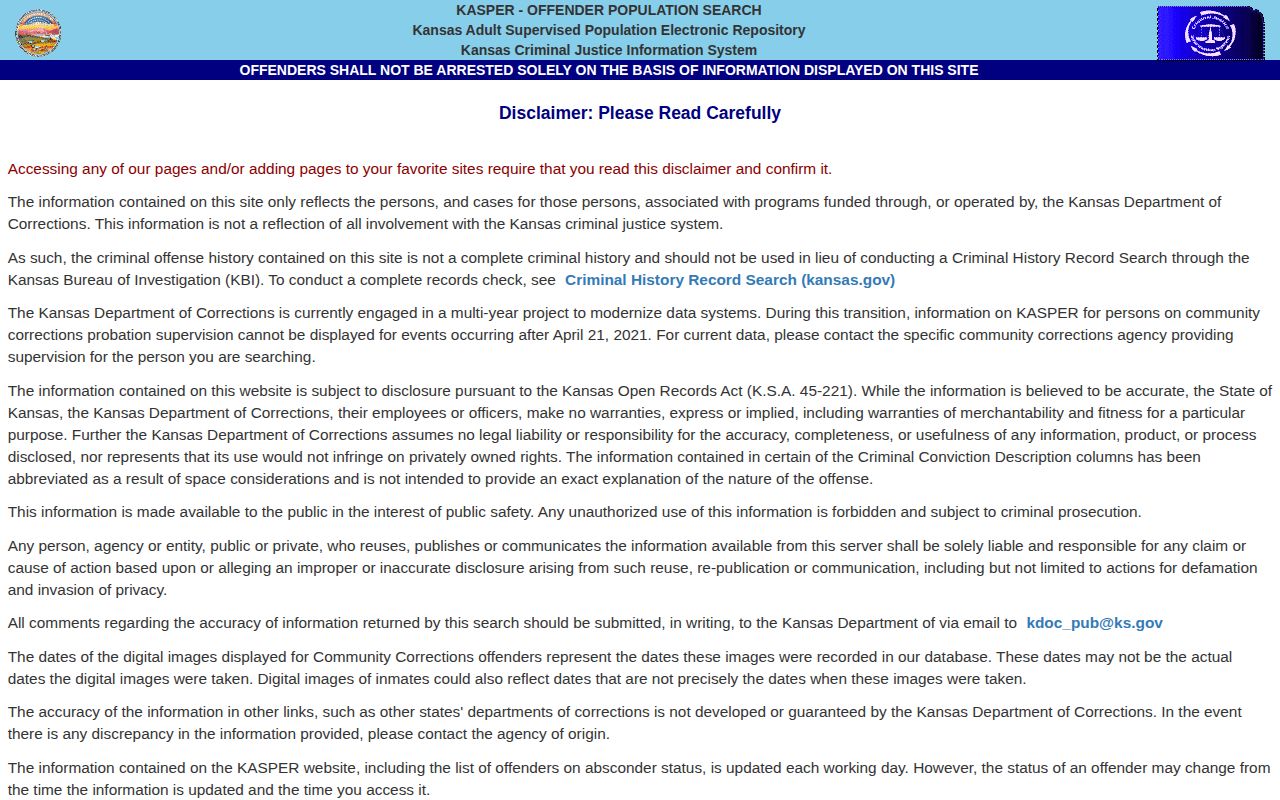
Those filters help separate similar names and connect a statewide prison record to a Kingman County conviction.
Kingman KDOC Record Fields
A KASPER detail can include the KDOC number, identity and physical descriptors, body markings, a corrections photo, conviction description, county and case, location, movements and dates, parole office, custody or supervision level, disciplinary findings, and the anticipated date. A corrections photograph is not necessarily the Kingman County booking image, and the database date may not be the capture date.
| Field | How to read it |
|---|---|
| Current location | A prison points to custody; a parole office may point to community supervision. |
| Movement history | Shows changes between facilities or supervision stages. |
| Supervision level | Describes continuing KDOC authority outside prison. |
| Anticipated Release Date | A calculation that can change, not proof of release. |
| Discharged status | Indicates the KDOC sentence and supervision ended. |
| Conviction county and case | Connects the record to the Kingman matter. |
K.S.A. 45-221(a)(29) preserves public corrections fields including name, photograph and identifiers, sentence information, parole eligibility, supervision level, specified violations and conditions, and facility or parole-office information. Protected medical and treatment material may still be withheld.
KDOC Working-Day Release Lag
Kingman exposes a current-only county roster with no post-release window. KASPER takes a different approach: it updates on working days and retains discharged state records within its stated coverage. A prison release late on a weekend may therefore not appear at once. The contrast explains why a missing local name and an unchanged state record can briefly coexist.
The KASPER disclaimer supplies the working-day caveat.
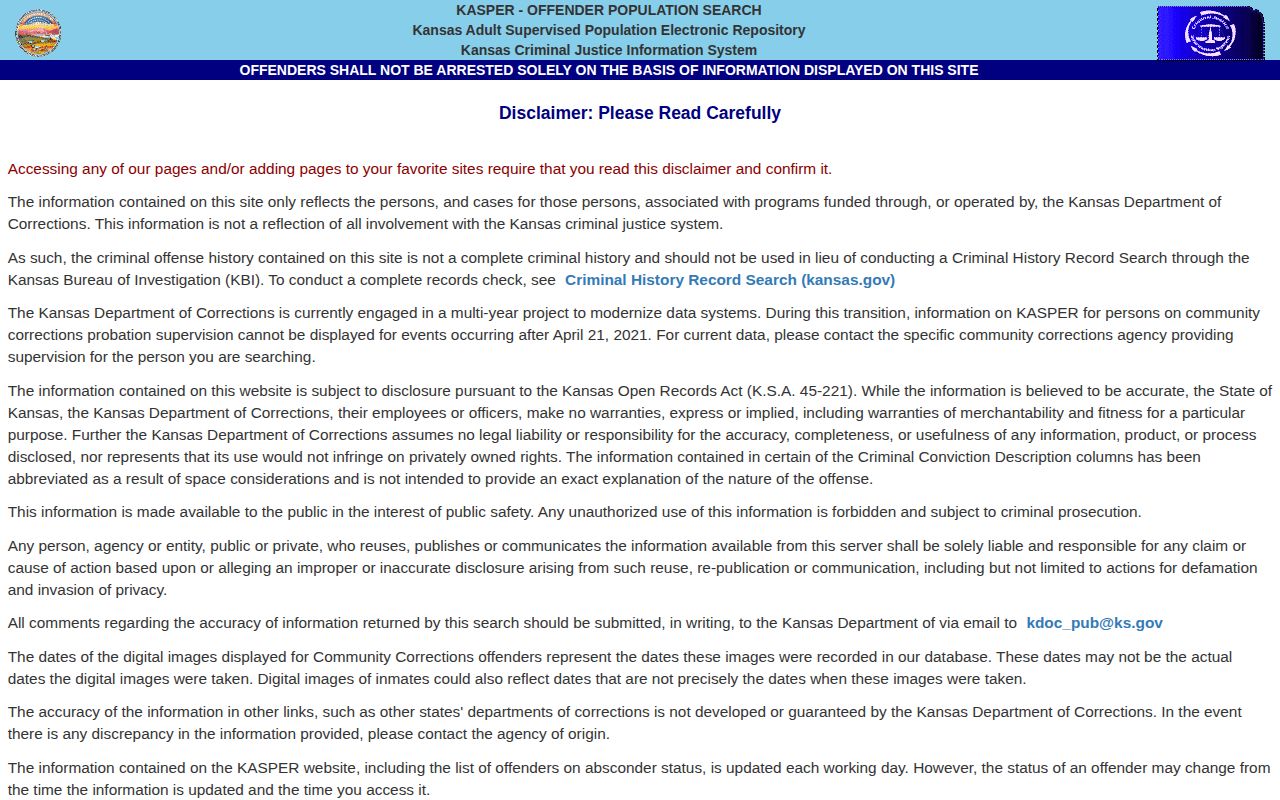
When timing matters, confirm the movement with KDOC or the relevant facility rather than assuming the database changed at the gate.
KDOC Anticipated Release Date
“Anticipated Release Date” is the exact Kansas label. It is calculated from controlling sentences, jail credit, consecutive or concurrent structure, statutory credit, forfeiture or restoration, program credit, and later orders. The date can move. It does not establish that a person actually left a facility.
For many eligible guideline sentences for crimes on or after July 1, 1993, K.S.A. 21-6821 caps good time at 15 percent of the prison portion. Qualifying categories can permit up to 20 percent, and subsection (e) permits up to 120 days of additional program credit for specified eligible residents and programs. Maximum available credit is not automatic credit. Older indeterminate cases, life terms, and offense-specific rules follow other provisions. County-jail computation is separate and cannot borrow KDOC percentages.
KDOC Release and Supervision Terms
Parole is discretionary release chiefly associated with eligible older indeterminate sentences. Postrelease supervision follows many determinate guideline sentences. Conditional release occurs under statutory computation and written conditions. Each can place a person outside prison while legal authority continues. Final discharge comes later.
Kingman County is assigned to the Great Bend Parole Office at 1806 12th Street, Great Bend, KS 67530, 620-200-2369. KASPER can display the parole office and supervision level, but office staff may limit confidential details. Probation differs from KDOC parole: a court may order probation or community corrections without a state-prison term. KASPER warns that community-corrections probation events after April 21, 2021 may be incomplete, so use the court case and named supervising agency for that status.
Request Kingman KDOC Discharge Proof
For a formal state record, use KDOC GovQA. Identify the person and KDOC number, name the existing discharge, sentence-computation, movement, or supervision record sought, and request an electronic response. GovQA provides tracking and correspondence. Ask for the public fields and allow redaction of protected material.
KDOC’s Sentence Computation Unit uses 785-296-3317 for anticipated-date questions. KASPER inaccuracies can be sent to kdoc_pub@ks.gov. Those channels serve different purposes. A data-correction email is not a release certificate, and Sentence Computation cannot turn a projected date into proof of an event that has not been recorded.
The KDOC locating guide explains discharged coverage and the anticipated-date warning.

The guide confirms why KASPER remains relevant after prison custody ends.
Kingman Jail Versus KDOC Custody
If the person remains in Kingman County Jail, use the sheriff roster, Kansas VINE, the jail record, and the court case. VINE covers participating adult county jails and does not cover KDOC prisoners. After a court commitment and transport, use KASPER. If a later KASPER record shows supervision, the person may be physically released but not discharged.
A new county booking can coexist with an older KDOC supervision record. That may reflect an alleged violation or a new case, not a contradiction. Likewise, a sheriff departure marked KDOC is a transfer, not a Kingman community release. The Kingman County Jail release page covers the local half of that boundary. BOP, USMS, and ICE tools apply only when the case record specifically points to them.
For older research, pair KASPER with the court journal entry. The conviction case explains the sentence and later court action, while KDOC movements show the corrections path. If an official result is missing, check spelling, identifiers, coverage, and expungement or reversal before drawing a conclusion. One no-result never proves release or discharge.
KDOC Parole Eligibility Records
The Prisoner Review Board’s public-comment schedule is a planning source, not proof of release. Kansas holds monthly sessions in Derby, Topeka, and Kansas City under the official KDOC procedures. Its listed-residents page says people named for one month are eligible for a hearing the next month and potential release the month after that. “Potential” is essential. A calendar entry does not record a grant, a gate date, or a completed movement.
The official source sweep found no standalone searchable database of individual PRB decisions. Later KASPER status or a targeted KDOC record request is the appropriate confirmation. Process materials describe outcomes such as a grant, denial or pass, continuation for more information, or service to a mandatory, conditional, or maximum date. Eligibility under K.S.A. 22-3717 depends on offense, sentence type, and date. Modern determinate guideline sentences often reach postrelease through computation, while discretionary parole chiefly concerns eligible old-law indeterminate cases.
KASPER should be checked after the hearing sequence because it can show the later location, movement, parole office, and supervision level. An eligibility list remains historically useful, but it cannot establish that the Board granted release or that a scheduled movement occurred. For formal proof, request the existing Board or KDOC record by name, KDOC number, case, and date.
Public Record Search
Sponsored Results