
Kingman County Release Meanings
Leaving the Kingman County Jail is not always a community release. A person may leave after posting bond, a court-ordered release, dismissal, time served, or completion of a county sentence. The same roster change can follow transport to a Kansas Department of Corrections facility, another county, treatment, the U.S. Marshals Service, or ICE. The sheriff’s public roster can even show people housed for another county. Physical location, the agency with legal custody, and the agency prosecuting the case can therefore differ.
Read each status narrowly. Bond ends jail custody under set terms while the case remains open. Time served satisfies the confinement ordered in that matter. Probation places a person in the community under court or community-corrections oversight. Parole, conditional release, and postrelease supervision mean someone is outside prison but remains under KDOC authority. Discharge is stronger: it marks the end of the state sentence and its supervision. A transfer ends Kingman’s physical custody but does not mean the person walked free.
| Departure | What it means | Best next record |
|---|---|---|
| Bond or court order | Community release may occur while a case continues. | Sheriff release entry plus court order |
| Time served or county sentence end | The ordered jail term in that matter is satisfied. | Release entry and sentencing journal entry |
| Probation | Community status under a court order. | Court register and named supervising agency |
| KDOC transfer | State custody begins or continues elsewhere. | KASPER movement and court commitment |
| Parole or postrelease | Physical prison release with KDOC oversight. | KASPER status and parole-office field |
| Discharge | KDOC sentence and supervision have ended. | KASPER plus a KDOC discharge record |
Kingman County Release Record Fields
There is no single universal Kansas “release record.” For the county jail, the useful document is usually an existing jail log or booking-and-release entry. Kingman has not published the exact local schema, so the following items are fields to request if recorded and releasable. They are not a claim that each booking contains every item. Ask for one identified booking or a clear date range, and ask the custodian to distinguish a community release from a transfer.
| Requested field | What it can show |
|---|---|
| Person and booking number | Connects the departure to the correct jail stay. |
| Booking date and time | Marks the start of that custody episode. |
| Physical departure timestamp | Shows when the person left the facility, if maintained. |
| Release mode or authority | May distinguish bond, court order, sentence end, or another basis. |
| Destination or receiving agency | Helps separate release to the community from transport. |
| Case, charge, or bond tie-back | Links the jail event to the legal matter. |
| Property acknowledgment | May document how retained property was handled. |
KASPER uses a different record. A KDOC result can show a corrections number, descriptors, convictions and cases, current location, movements, supervision level, parole office, disciplinary information, and an “Anticipated Release Date.” It can remain visible after physical release or final discharge. A court register supplies still another layer: bond, dismissal, sentencing, jail credit, probation, commitment, revocation, satisfaction, discharge, and expungement events.
Request Kingman County Release Records
The Kingman County Sheriff’s Office provides the local records route. Its published policy says regular inspection and request hours are 8:00 a.m. to 5:00 p.m., Monday through Friday, except county holidays. Dispatch operates around the clock for an immediate custody check. The office is at 120 N. Spruce Street, Kingman, KS 67068, and the main number is 620-532-5133. The county’s jail information page links the open-records entry.
A narrow request is easier to route and less likely to require new analysis. The sheriff’s policy lists jail logs and mug shots among frequently requested records. It also says a written request may be required and should include the requester’s name, mailing address, phone number, and a detailed record description. The form is optional rather than the only request method.
- Identify the person, booking number if known, and the exact date or Central Time interval.
- Ask for the existing jail log or booking-and-release entry and any releasable physical departure time, release type, and receiving agency.
- State that community release should be distinguished from transfer.
- Choose an electronic format, request a cost estimate, and state a fee ceiling.
- Keep the response and match it with the court order or custody-system event.
Under K.S.A. 45-218, an agency must act on a request as soon as possible and by the end of the third business day. That is a response deadline, not a promise that a complex review will be complete. A delay response should explain the reason and earliest availability. K.S.A. 45-219 permits reasonable actual-cost fees and advance payment.
The sheriff’s policy gives more detail about cost and scope. Paper copies up to 25 pages are listed at 25 cents per page outside the limited free walk-in report allowances. Mailed offense and crash reports have separate stated charges, while audio or video is listed at $20. Staff time is $15 per hour. The office may estimate the work, require prepayment, collect final payment before production, and refund an overestimate. Ask for an itemized statement when costs are unclear, and verify every rate before submitting payment.
A strong interval request asks for existing jail-log entries between exact Central Time endpoints. It should request fields already kept that identify physical departures and distinguish community release from transfer. A person-specific request can name the jail log, booking-and-release entry, and booking photograph tied to a booking number and date. Invite redaction and production of any separable open portion. Avoid asking staff to summarize the whole case or decide why an event happened, because KORA does not require a custodian to create that analysis.
Kingman County Record Access Limits
The Kansas Open Records Act begins with public access but contains specific exceptions. Juvenile, sealed, expunged, medical, treatment, victim-sensitive, and qualifying investigative information can be restricted. An agency may redact closed material and provide the separable open part. If access is denied, ask for the legal basis. KORA requires production of existing records, not a new explanation, custom statistic, or legal conclusion.
KDOC records have their own useful rule. K.S.A. 45-221(a)(29) preserves public corrections fields such as name, photograph and identifiers, sentence data, parole eligibility, supervision level, certain violations and conditions, and facility or parole office. For a durable state discharge record, use the KDOC GovQA request route rather than treating an old anticipated date as proof.
Expungement is a court order, not a release event. Many waiting periods under K.S.A. 21-6614 begin only after the sentence is satisfied or probation, parole, postrelease, conditional release, or another listed supervision ends. Rule 22 and online conversion limits can also keep otherwise public older material off the web. The courthouse terminal or clerk may hold an open record that the portal does not display.
Find Kingman County Released Inmates
Start with custody type, not with one all-purpose database. For a person last held at Kingman County Jail, the Current Inmates page is a first check. Presence supports current custody at check time. Absence does not supply a release date and does not prove community release. The public page has no released filter, release reason, 24-hour or 72-hour window, stated update pace, or retention period.
- Check the Kingman current roster and note the time of the check.
- Search the Kingman reporting agency in Kansas VINE and read the exact status and event date.
- Call the jail or request its release entry, including whether another agency took custody.
- Search the Kingman criminal case for the order that authorized release or transfer.
- If the record shows commitment to KDOC, switch to KASPER.
- Use federal or immigration tools only when a docket, hold, or transfer points there.
The official sweep found no Kingman 24-hour or 72-hour release feed as of July 2026. A bounded sheriff-log request can recreate an official interval. For a one-day check, the Kingman County Jail Releases: 24 Hours page explains that fallback. Give exact start and end times in Central Time and ask that transfers be separated from community releases.
KDOC Search for Kingman Releases
KASPER, the Kansas Adult Supervised Population Electronic Repository, is broader than a prison roster. KDOC says it covers people sentenced to the Secretary’s custody since 1980 who are incarcerated, under post-incarceration supervision, or discharged. It does not cover people sent to Kansas only through interstate compact. A Kingman conviction may lead to a prison anywhere KDOC assigns, even though no state prison was identified inside Kingman County.
Accept the KASPER disclaimer, then search the exact KDOC number when available. Otherwise combine name, date of birth or age, and conviction county. Compare identifiers before opening a result. A prison location signals custody. A parole office or parole, postrelease, or conditional-release status can show physical release with legal supervision. “Discharged” means the KDOC sentence and supervision ended. Updates occur on working days, so a weekend change can lag.
| Search field | Best use |
|---|---|
| KDOC number | Most direct match when known |
| First, middle, last name | Broad identity search |
| Alias | Checks another recorded name |
| Date of birth or age | Separates similar names |
| Conviction county | Narrows to a Kingman case |
| Parole county | Finds a supervision assignment |
The official KASPER search shows these filters and photo options.
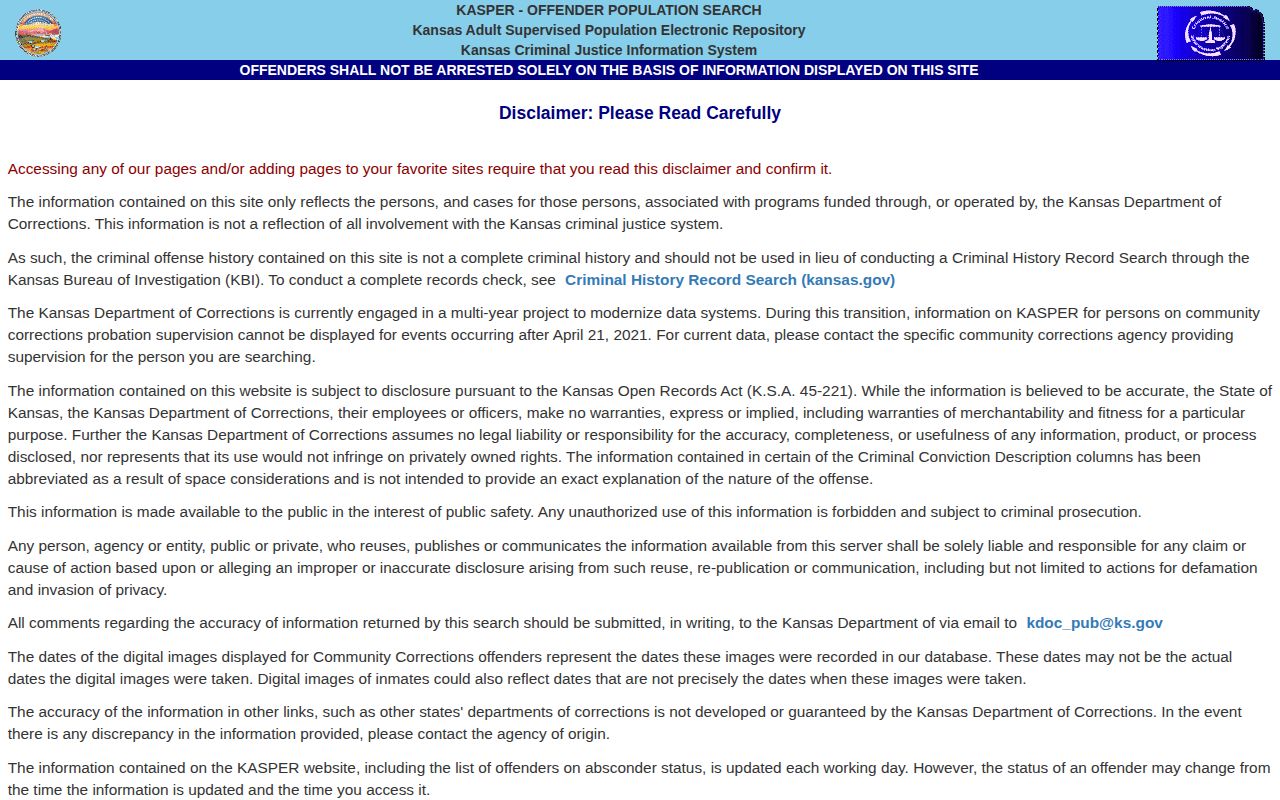
The screen helps narrow a state record, but its anticipated date remains an estimate rather than proof that a gate release occurred.
Kingman Release Orders and Departure
Kingman release proof often needs two records. The court journal entry explains legal authority. The jail log documents physical departure. Search the Kansas court system by case number when possible, or narrow a name search to Kingman County and the criminal case type. A bond order may precede the actual jail exit while staff resolve paperwork or other holds. A dismissal can end one charge while another hold continues. A commitment normally points to transport, not freedom.
The Kansas District Court Records guide explains portal coverage and courthouse access.
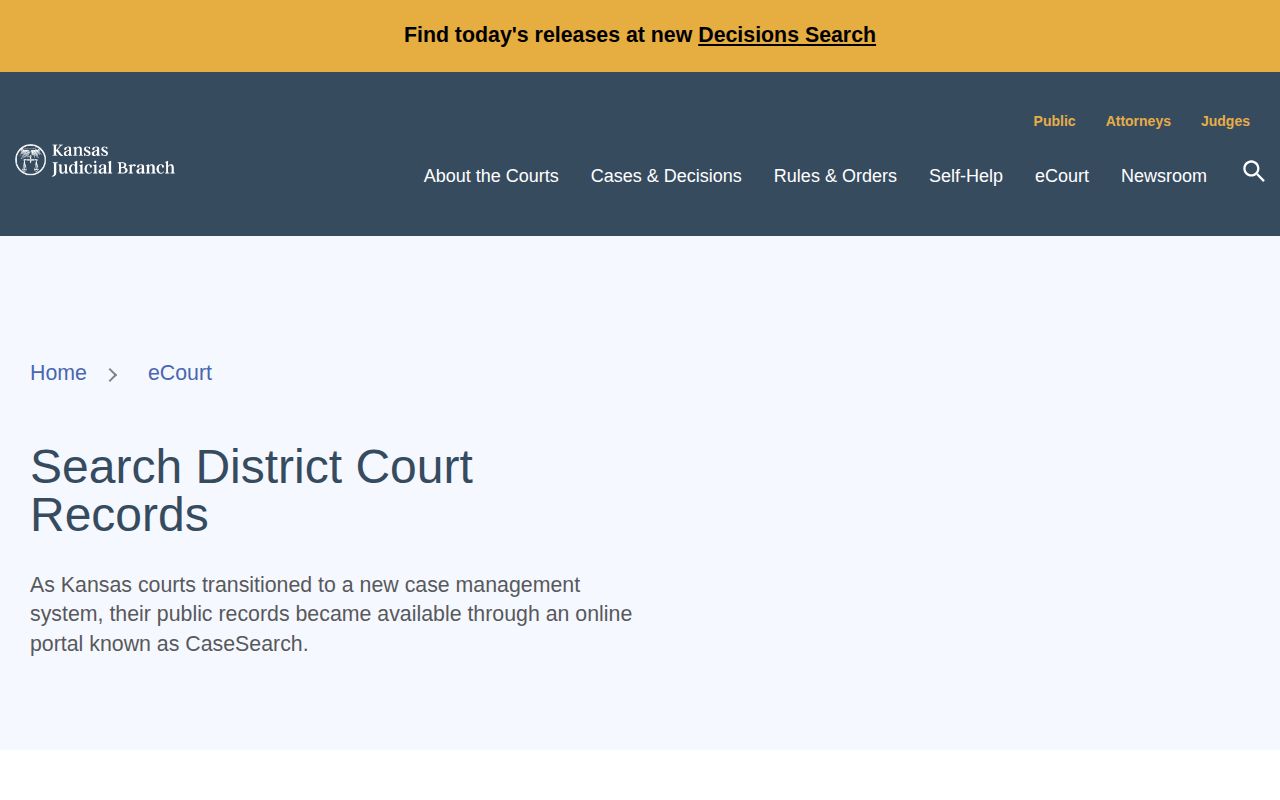
For older or certified public material, the Kingman District Court clerk is the fallback. The office is on the courthouse third floor at 130 N. Spruce Street and uses split counter hours, 8:00 a.m. to noon and 1:00 to 4:00 p.m. on weekdays. A Kingman case number normally starts with KM.
Online case information and online documents do not have identical coverage. Public documents converted from systems used before Odyssey may be absent from the web even when courthouse access remains available. Public courthouse kiosks can supply some converted documents. Rule 22 also places some categories behind stricter access limits. Search by the full KM case number from a journal entry when possible, then compare the register of actions with the document itself instead of relying on a short event label.
Property After Kingman Jail Release
The Kingman jail handbook adds a local detail that status databases cannot show. Intake property is inventoried and receipted. At dismissal or transfer, property that cannot go with the person may be shipped at that person’s expense when funds exist, picked up by a designee, or stored. After 90 days, unclaimed property becomes sheriff property for auction or donation.
This rule matters when a roster change was a transfer. Property left behind is not proof that the person entered the community. Ask the jail how the departure was classified and how the documented property procedure applies. The handbook does not publish a routine release hour, exit door, family waiting rule, or ride arrangement, so none should be inferred.
Other Kingman Release Systems
Kansas VINE covers participating adult county jails, including Kingman’s linked route, but not KDOC prisoners. It is a custody-event and notification service rather than a certified historical ledger. A “released” event should be checked with the jail for the physical time, release type, and any remaining hold. The sheriff’s VINE explanation identifies phone, internet, and mobile access.
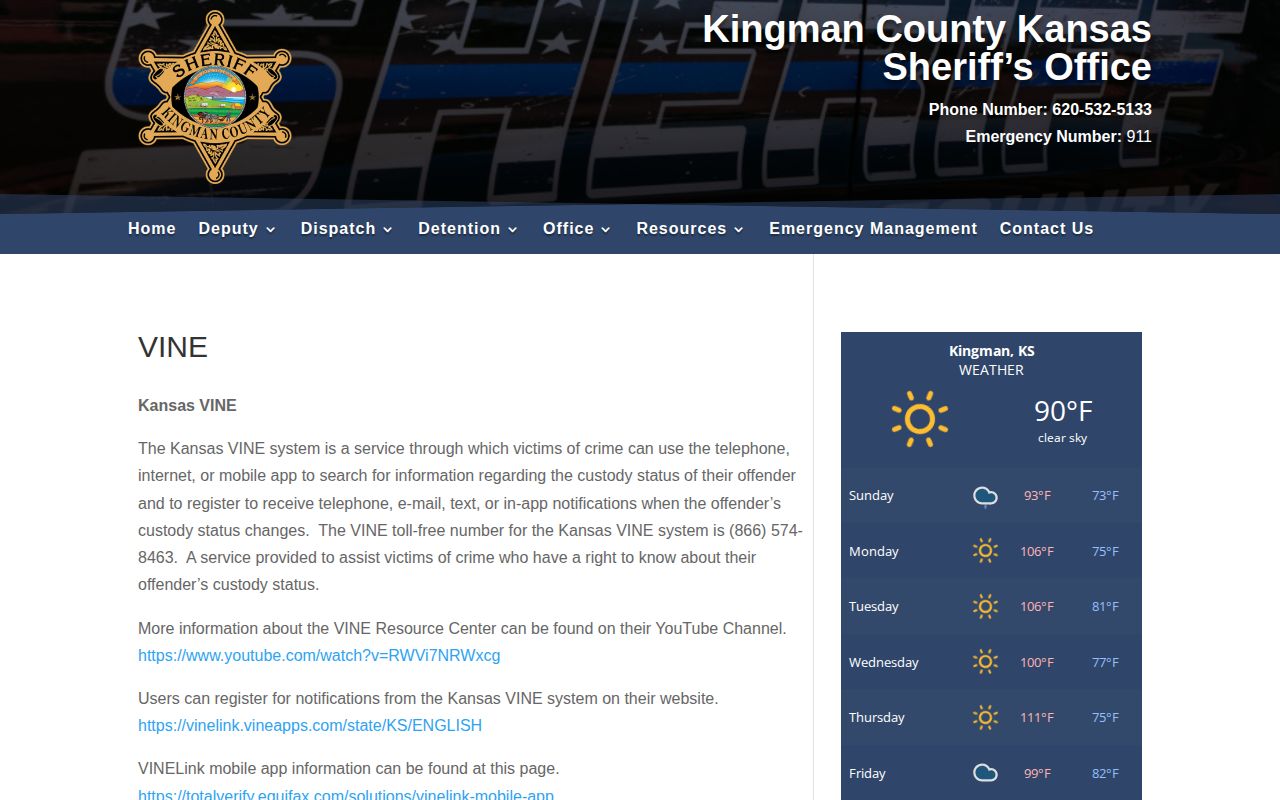
The local page supplies the correct county-jail notification route, while KASPER remains the state-prison route.
For sentenced federal custody, the BOP locator may show a release date and “Released” or “Not in BOP Custody,” but that means only that BOP custody ended. Federal pretrial custody requires the actual jail, the U.S. Marshals Service, and the federal docket. ICE’s locator is a current-location tool, not a historical release archive. Use it only when an immigration hold or transfer appears. No current Kingman federal or ICE contract was verified.
Compare Kingman Release Sources
Conflicts are possible because each system records a different layer and may update on a different schedule. A court release order can coexist with a roster entry while processing or another hold remains. KASPER can show a facility after the county roster drops a name because the person moved into state custody. A supervision record and a new local booking can both be accurate.
| System | Best question | Main limit |
|---|---|---|
| Kingman current roster | Is the person shown in the jail now? | No released view or departure time |
| Sheriff release entry | When and how did the person leave? | Must be requested |
| VINE | Did the jail transmit a custody event? | May lag and does not explain the case |
| Court record | What legal order or disposition occurred? | Does not prove the physical exit time |
| KASPER | Is a state-sentenced person incarcerated, supervised, or discharged? | Working-day updates; anticipated dates can change |
| BOP or ICE | Does a case-specific federal system apply? | Each has narrow custody coverage |
Kingman County Release Facilities
Kingman County Jail is the only verified adult detention site physically identified in the county. KDOC facilities serve people committed from Kingman cases but are statewide, not a local county jail. Federal and immigration channels are conditional and should be used only when a record names the agency.
Choose the facility link that matches the record, not a guess based on where the case began. When two agencies appear, contact both and ask which one held the person at the time in question. This avoids labeling a transport as a release and keeps the search tied to the office that created the controlling record.
Public Record Search
Sponsored Results