
Kingman Release Mugshot Sources
Start with provenance, meaning where the image came from. The Kingman County sheriff roster often shows a booking image while a person remains on the current view. It exposes no post-release archive. Once the entry disappears, the photo may no longer be accessible there even though the sheriff still holds an existing record.
The sheriff's written public-records policy lists mug shots among frequently requested records. That makes the records office the direct fallback. A Kansas Department of Corrections image is a separate source. It may have been made during state processing rather than the Kingman booking, and KDOC warns that an image date shown in its database may not be the capture date.
Find Kingman Booking Photos
Use the custody path to choose the source. The county roster and sheriff request serve Kingman Jail bookings. KASPER serves people committed to KDOC. VINELink may show an agency-supplied image, but its core purpose is custody notification, not photo preservation.
- Record the person's correct name, booking number, and booking date from an official source.
- Check the current Kingman roster. Save the official URL and the time checked, not a commercial copy.
- If the booking has left the view, request the existing mug shot from the sheriff and cite the booking identifiers.
- If a Kingman case led to state prison, search KASPER and label any displayed image as a KDOC corrections photo.
- Confirm release separately through the sheriff log, VINE event, court order, or KDOC movement and status.
A photo search cannot answer where the person went. A transfer can remove a Kingman roster entry while the person stays in custody elsewhere. Use the Kingman County released inmate search to resolve that status question.
Compare Kingman Mugshot Records
Each image channel answers a different question. Keep its agency name and access date beside the image so an old copy is not mistaken for current status.
| Source | What the image means | Main limit |
|---|---|---|
| Sheriff current roster | Booking image tied to a current Kingman public roster entry | No official released archive or retention window is shown |
| Sheriff records request | Existing county booking image for the identified booking | Disclosure and format remain custodian decisions |
| KDOC KASPER | Corrections image tied to a state offender record | Not necessarily the Kingman County booking photo |
| VINELink | Agency-supplied image when available | Not guaranteed and not a photo archive |
| News or third party | A lead to an incident, name, or date | May be selective, stale, mislabeled, or detached from official status |
Request Kingman Release Mugshots
Use the county jail information and open-records entry or call 620-532-5133. Identify the booking by name, booking number, and date. Ask for the existing booking image in electronic form if available. The request should remain narrow and should not ask staff to research or create a new account of the case.
The sheriff policy states weekday request hours of 8:00 a.m. to 5:00 p.m., excluding county holidays. It lists photos at $20 per disc and staff time at $15 per hour, while other actual costs can apply. Ask whether electronic delivery avoids a disc and request an estimate before charges exceed a chosen amount. Recheck fees before submitting because policies can change.
Under K.S.A. 45-218, the office must respond as soon as possible and by the end of the third business day, but that deadline is not a promise of production. If a photo is withheld, ask the custodian to cite the legal basis. Kansas law treats visual copies and investigative records with nuance, so do not promise access before the office reviews the request.
The local policy’s frequently requested-record list is important but limited. Its reference to mug shots confirms that the office recognizes this type of request. It does not guarantee that every image is open, that the desired file still exists in the same format, or that a disc charge applies to electronic delivery. The policy also allows an estimate and prepayment. A precise request can ask the office to state the available format and current cost before work begins.
Include only identifiers needed to locate the correct booking. A booking number and date are more useful than a long account of allegations. Ask for the image tied to that custody event and, if needed, the booking-and-release entry that confirms its source. Medical, juvenile, victim-sensitive, sealed, expunged, or unrelated investigative material should not be requested. If open and closed information share one record, Kansas access rules allow the office to separate protected portions from releasable material where applicable.
Kingman KDOC Photo Differences
K.S.A. 45-221(a)(29) expressly identifies a KDOC photograph and listed corrections fields as open. KASPER can retain records after physical prison release and may show incarceration, supervision, or discharge. That persistence makes it useful after a county roster image disappears, but only when the person entered the state corrections system.
The official KASPER search page illustrates photo toggles and offender-search fields.
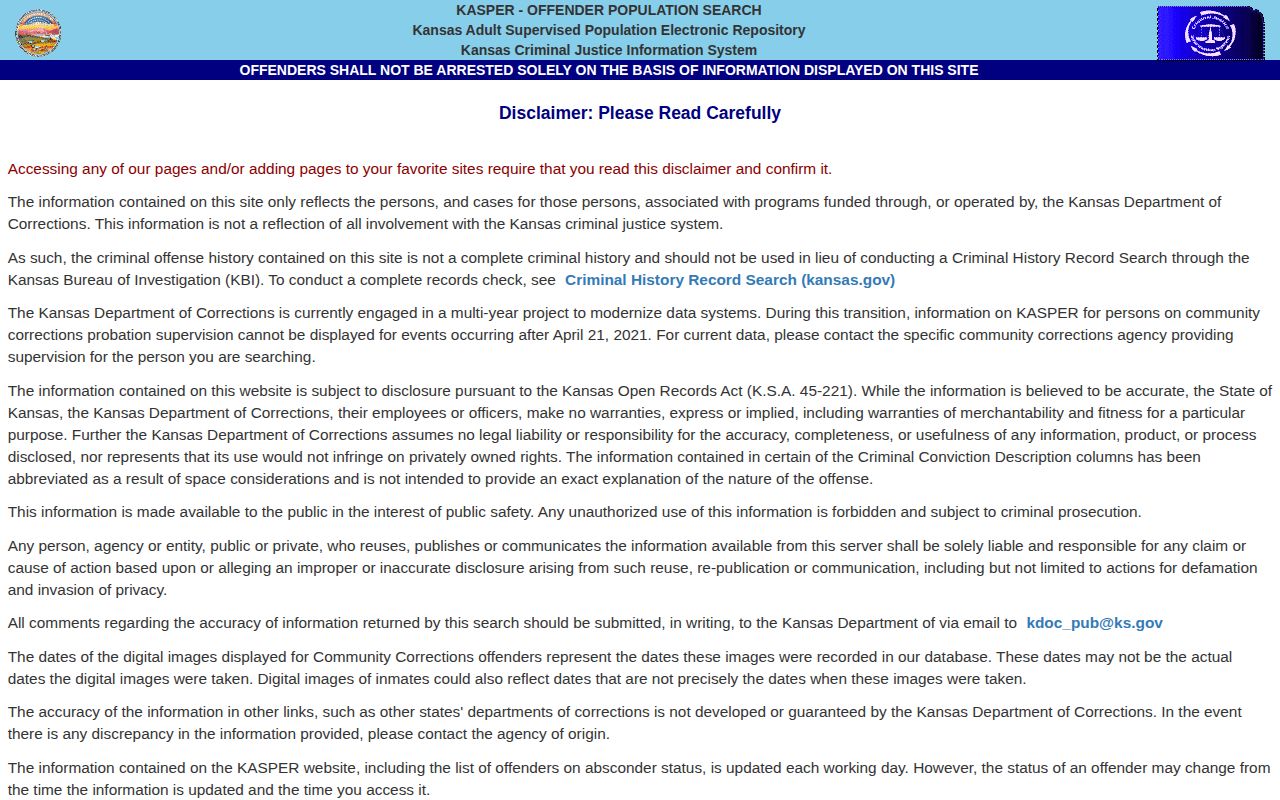
The displayed image is evidence of KDOC's search interface, not a Kingman booking gallery. Label a resulting photo “KDOC corrections image” unless the agency record establishes a different origin.
KASPER’s retained record can include identity descriptors, conviction county and case, current location, movements, supervision level, parole office, and an anticipated release date. Those fields help verify that the correct state record was opened. They do not transform its photograph into the earlier county mugshot. If the image matters as a record, preserve KDOC as the source and request formal corrections material through GovQA when a durable response is needed.
Kingman Mugshots Leave Roster
Kingman's public page is current-only. It shows name, image where supplied, booking number, charges, bond, arresting agency, booking date and time, age, sex, and race. It does not display a release date, release reason, 24-hour window, or 72-hour window. When a record leaves that view, the loss of the image does not disclose what happened.
The official roster screenshot shows the source context.
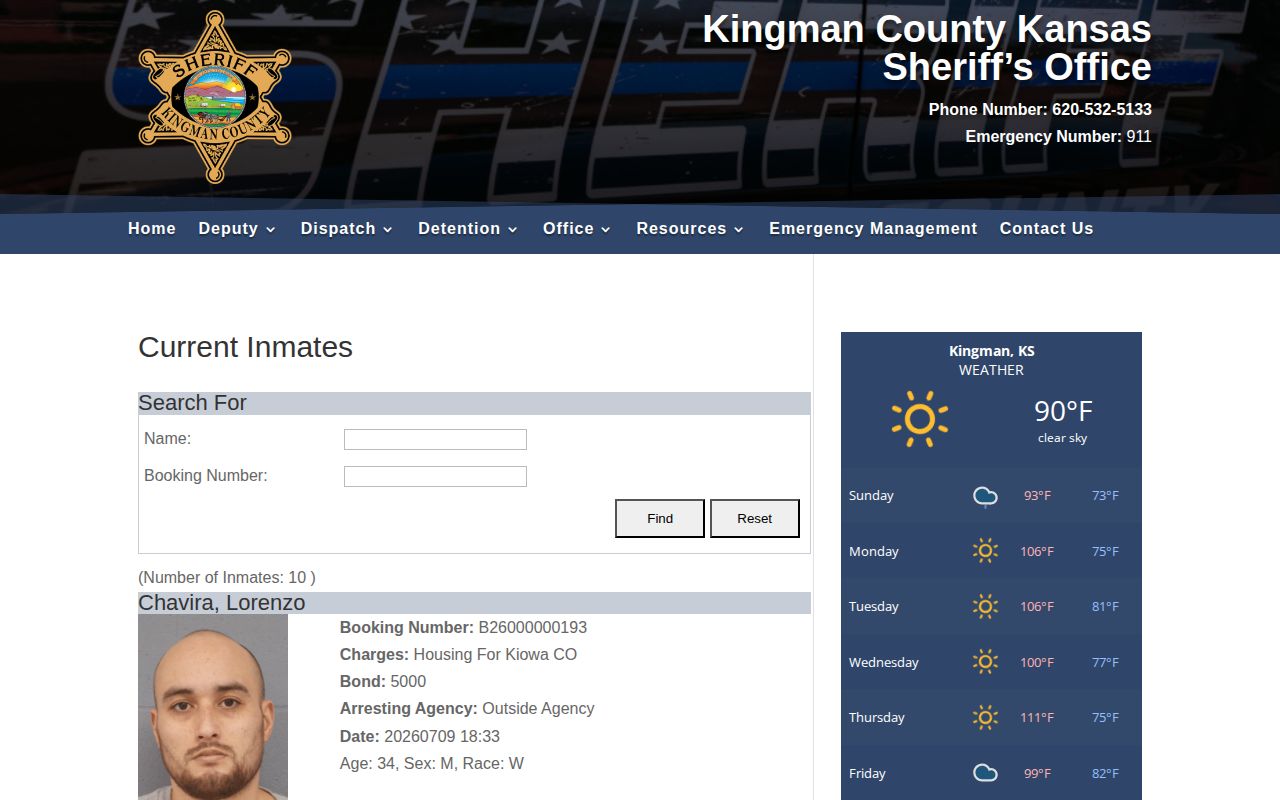
Read the “Current Inmates” label with the image. A former entry needs a sheriff record and release verification, not a caption inferred from roster absence.
Read Kingman Photos Carefully
Arrest, conviction, custody, release, and discharge are different events. A booking image records an association with a booking. A court case explains disposition. The sheriff log documents physical departure. VINE can report a county-jail custody event. KASPER shows state custody, supervision, movements, and discharge within its scope.
- Booking photo
- An image associated with intake or a custody record.
- Release
- Departure from one facility, which may be into the community or into another agency's custody.
- Transfer
- A move to another jail, prison, or authority rather than community freedom.
- Discharge
- The end of supervision for the relevant state sentence, not merely departure from a building.
- Expungement
- A court-ordered restriction affecting qualifying records; it is not automatic upon release.
Kansas research identified no specific anti-pay-to-remove statute. That gap is not a reason to rely on commercial galleries. Such copies can be stale, mislabeled, or remain online after an official record changes. Use the originating agency and avoid republishing more personal detail than is needed to identify the correct official record.
Corrections also require source-specific routes. Ask the Kingman sheriff about an incorrect county booking image or record. For KASPER data, KDOC directs corrections to kdoc_pub@ks.gov, while a formal records request can go through the KDOC GovQA route. A court order affecting access should be handled through the court and the agency that holds the copy. One correction does not ensure that an unrelated third party will update its own version.
Use restrained captions. State “booking image displayed by the Kingman County Sheriff's Office” or “corrections image displayed by KDOC,” followed by the date accessed. Avoid calling either image a release photo unless the agency actually created it for a release event. The photo and the custody result should remain separate claims, each supported by its own official record.
Keep the official URL with any saved reference. Record the agency, access date, booking or KDOC number, and the exact status words without copying unrelated allegations or private details. If the image and identifiers do not align, stop and compare the underlying record. Similar names, aliases, and old copies can cause a serious mismatch. The safest result is the smallest accurate statement supported by the originating office.
Public Record Search
Sponsored Results