
Kingman Federal Custody Departures
Federal/USMS contract custody is a conditional channel, not a verified Kingman County facility. Research found no local federal prison and no confirmed Kingman contract for routine federal detention. A federal path becomes relevant only when the Kingman jail record, an arresting-agency field, a detainer, a transfer entry, or a District of Kansas case names federal authority. Do not infer a contract from the fact that USMS can use local contract beds elsewhere.
A departure from Kingman County Jail can mean transfer to USMS, another contract jail, a federal detention center, BOP custody after sentencing, or release under a federal court order. Only one of those is an ordinary community release. The sheriff booking and release entry should identify the receiving agency or destination if that information was recorded and is releasable. The federal docket explains the legal order. The actual jail documents physical custody.
| Federal stage | Primary record | What departure may mean |
|---|---|---|
| Pretrial under USMS | Actual jail, USMS, and District of Kansas docket | Release by court order or transfer between detention sites |
| Sentenced in BOP custody | BOP Inmate Locator | Current BOP location or a displayed release date |
| After BOP custody | BOP result and federal docket | Outside BOP, possibly under federal supervision or another authority |
Confirm Kingman Federal Releases
Classify the case before searching. The Bureau of Prisons locator is strong for sentenced federal custody from 1982 forward. It is weaker for a person who remains solely under USMS pretrial authority. USMS does not offer an equivalent public historical release locator. PACER contains federal judicial orders, while the jail and USMS hold the physical-custody facts.
- Read the Kingman booking or release record for “USMS,” a federal hold, a receiving agency, or a transfer destination.
- Search the federal docket for the detention, release, sentencing, or supervised-release order tied to the correct person and case.
- If the person entered sentenced federal custody, use the BOP Inmate Locator by identifier or name.
- For pretrial custody, contact the actual jail and the assigned District of Kansas USMS office. Do not assume Wichita controls solely because it is nearby.
- Compare dates and exact terms. “Not in BOP Custody” does not rule out another jail, another agency, or federal supervision.
- Request a specific record when the public sources conflict, and preserve the source, time checked, and remaining uncertainty.
The Kingman County release-record path explains how to obtain the local sheriff entry when the federal trail begins with a Kingman booking. Absence from the county roster alone is not proof of federal release.
Kingman BOP Release Search Fields
The BOP locator supports number searches using a BOP register number, DCDC number, FBI number, or INS number. Its name route allows optional age, race, and sex filters. Results can show name, register number, age, race, sex, release date, and location. Compare identifiers carefully, especially when names are shared.
BOP may display “Released” or “Not in BOP Custody.” Read that phrase narrowly: the person is no longer in BOP custody. It does not show that every federal supervision term ended, that no state or local hold exists, or that the person entered the community. First Step Act credit recalculation can also make a displayed date stale. The federal docket can show supervised-release terms and later court action.
The official BOP locator supplies the sentenced-custody fields and released-result columns.
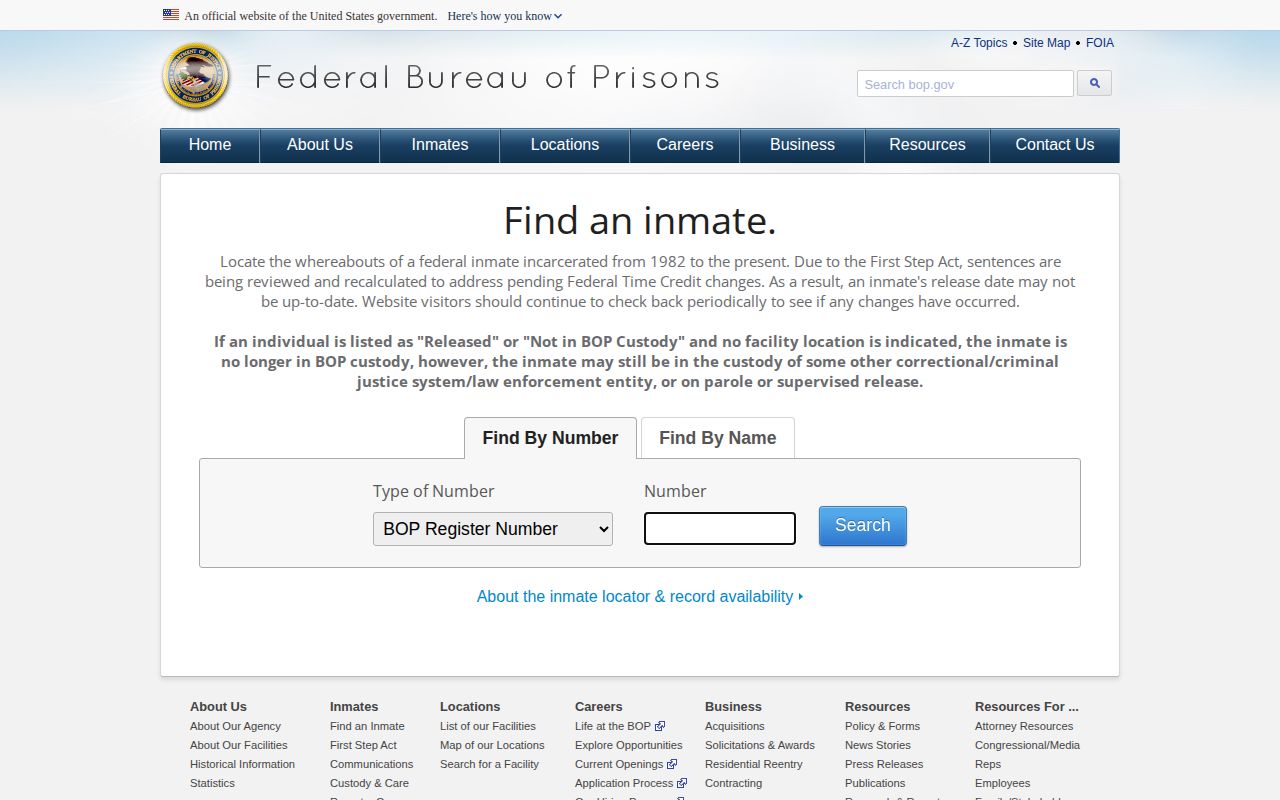
The screenshot demonstrates the interface and status columns. It does not establish a Kingman County connection or the present status of any person.
- BOP custody
- Custody administered by the Bureau of Prisons after entry into its system.
- USMS custody
- Federal detention authority commonly involved before trial and during transport.
- Supervised release
- Court-ordered federal oversight after imprisonment.
- Detainer
- A request or notice that another authority may claim custody.
Kingman Federal Pretrial Release Records
A federal defendant can be held under USMS authority in a contract jail without entering sentenced BOP custody. That person may not appear in the BOP locator in the way a sentenced prisoner does. Use the actual jail for location and departure, USMS for custody routing, and the District of Kansas docket for detention and release orders. A docket order authorizes an event, but it does not prove the precise time someone walked out or transferred.
Federal orders may impose conditions while the case continues. Later supervised release is a distinct post-sentence status. Do not treat either as final discharge. If a docket shows release but a jail still lists the person, processing or another hold may remain. If the jail shows departure but the docket lacks a community-release order, investigate transfer first.
USMS has no public historical release search equivalent to BOP. A narrow request should identify the defendant, case number, date range, actual jail, and exact custody or transport record sought. PACER may charge for court access under its own current rules, so review the live terms instead of publishing an unsupported fee.
The actual jail may be outside Kingman County. USMS can move a defendant among contract beds as court dates, transport, and bed space require. A location change therefore does not establish a release decision. Search the docket for the judge's filed order, then ask the jail or USMS which physical movement followed it. Keep the judicial event and the transport event as separate entries in the timeline.
Kingman Federal Custody Contacts
The District of Kansas has multiple USMS offices. Verify assignment from the federal case or agency record rather than choosing by distance. The published contacts provide a routing path; they are not a promise that staff will disclose restricted transport or security information.
Kansas City: 913-748-8550
Topeka: 785-596-9470
Wichita: 316-765-6339
District of Kansas office directory
If the federal clue came from Kingman County Jail, contact the sheriff at 620-532-5133 for the local release or transfer entry. Records inspection hours are 8:00 a.m. to 5:00 p.m. Monday through Friday, excluding county holidays. Immediate custody checks and document requests use different workflows.
Kingman Federal Release Record Trail
A sound record trail may require three agencies. The Kingman sheriff record can document when local custody ended and who accepted the person. The federal court file can document detention authority, release conditions, sentencing, or supervised release. BOP can document its own sentenced-custody status and release date. None should be stretched to answer another agency's question.
When a Kingman record says “federal hold” or “USMS transfer,” quote the exact phrase and follow the named authority. Do not rewrite it as “released federally.” Ask whether the person walked into the community, entered another jail, or moved into BOP custody. A BOP release result later in time still needs the federal docket when ongoing supervision matters.
Dates can describe separate points in the chain. A judge may sign an order before transport staff complete the move. The sheriff may record a local departure before the receiving jail books the person. BOP may later revise a calculated date after credit review. Build the timeline from labeled events rather than forcing every system to show one matching timestamp.
BOP's locator begins with federal custody records from 1982 forward, so it is not a universal archive for older federal confinement. Its number routes are also system-specific: a register, DCDC, FBI, or INS identifier must be entered in the field that accepts it. If a name search produces several matches, compare age and the other displayed descriptors rather than assuming the first result belongs to the Kingman-related case.
For a retrospective BOP record, the BOP FOIA route may be appropriate. Frame the request around an existing, identified record and expect lawful redactions. Collect only the details needed to verify the custody transition.
A formal federal request can seek the identified custody or release record, but it should not ask an agency to decide the meaning of a rumor or compile a new chronology. Name the existing document, date range, identifier, and facility when known. A partial response may still establish the agency handoff even when protected details are removed.
Note: No federal prison or USMS contract facility was verified in Kingman County, so every federal search needs a case-specific trigger.